
Overview
Urban mobility systems, ranging from connected autonomous vehicles, to ground and emerging low-altitude air transportation systems, are undergone a profound transformation, led by rapid technological advances in automation, communication and artificial intelligence. My research studies multi-scale mobility systems by advancing and leveraging the state-of-art control, machine learning and transportation theories. Our research aims to build safe, autonomous and human-centered mobility systems that can adapt and respond to environmental changes and societal demands of future cities.

Theories and methodologies:
- control theory
- dynamical modelling
- machine learning and AI
- optimization
- traffic flow theory
Research topics of mobility systems:
- connected autonomous vehicles
- mixed autonomy traffic
- urban air mobility

Highlights
Model-based Control: Boundary control of stop-and-go traffic
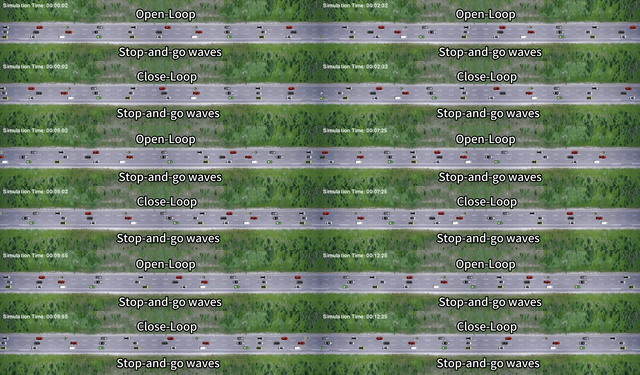
This thread of work provides control tools that have been previously unavailable for suppressing stop-and-go oscillations in congested traffic using actuation that is very sparsely located along the freeway, such as ramp metering or variable speed limits. The macroscopic PDEs are particularly suited for modeling large-scale and congested traffic flow patterns, such as the stop-and-go traffic. The aggregated state values (i.e. density,
speed, and flow rate) in the models evolve in continuous temporal and spatial domains. Focused on several macroscopic-level traffic problems, our research developed a methodological PDE model-based control framework for boundary actuation and estimation. The backstepping control method is employed which only requires sensing and actuating of state values at boundaries to regulate continuous in-domain values to the desired reference system. The proposed methodology is practical meaningful and relevant since the point actuation and sensing overcomes the technical and financial limitations of implementing sensors and actuators in large-scale transportation systems. We also consider the boundary control problem on freeway traffic of multi-lane, multi-class, and multi-segment.
Featured Publications
- H. Yu and M. Krstic, “Traffic Congestion Control by PDE Backstepping, ” Birkhäuser, 2022.
- H. Yu and M. Krstic, “Traffic congestion control of Aw-Rascle-Zhang model,” Automatica, vol. 100, pp. 38-51, 2019. DOI: 10.1016/j.automatica.2018.10.040.
- H. Yu, Q. Gan, A. M. Bayen, and M. Krstic, “PDE Traffic Observer Validated on Freeway Data,” IEEE Transactions on Control Systems Technology, vol.29, pp.1048-1060, 2021, DOI:10.1109/TCST.2020.2989101.
- Y. Zhang, H. Yu, Jean Auriol, Mike Pereira, “Mean-square Exponential Stabilization of Mixed-autonomy Traffic PDE System, ” Automatica, 2024, DOI: 10.1016/j.automatica.2024.111859.
Learning-based modelling and control of mixed traffic

Model-based approaches usually rely on assumptions and knowledge of the system dynamics. For traffic systems, the calibration of model parameters can be laborious, time-consuming, and highly associated with certain transient traffic conditions. Considering the uncertain dynamics and different performance metrics, it is desirable to have an approach with modest tuning to adapt to various problems. Recent developments in Reinforcement Learning (RL) have enabled model-free control of high-dimensional continuous control systems through a
complete data-driven process. The model-free RL approach does not have prior assumptions of the model structure and learns a control policy through interactions with the system directly. We developed RL state feedback controllers for congested traffic on a freeway segment. We employed proximal policy optimization, a deep neural network-based policy gradient algorithm, to obtain RL controllers through an iterative training process with a macroscopic traffic simulator. RL controllers are found to have comparable performance with the conventional feedback controllers in a traffic system with the perfect knowledge of model parameters. Remarkably, the RL controllers that were obtained from stochastic training processes outperformed the conventional controllers in an uncertain environment.
Featured Publications
- C. Zhao, H. Yu, “Observer-Informed Deep Learning for Traffic State Estimation With Boundary Sensing, ” IEEE Transactions on Intelligent Transportation Systems, 2023, DOI: 10.1109/TITS.2023.3318299.
- C. Zhao, and H. Yu, “Learning “Look-Ahead” Traffic Dynamics in a Ring Road with Physics-Informed Neural Networks, ” The 6th Annual Learning for Dynamics & Control Conference, University of Oxford, England, pp. 142-154, PMLR.
- Y. Zhang, and H. Yu, “Neural Operator for Boundary Control of Traffic PDE Models, ” The 6th Annual Learning for Dynamics & Control Conference, University of Oxford, England, pp. 554-565, PMLR.
- H. Yu, S. Park, A. M. Bayen, S. Moura, and M. Krstic, “Reinforcement Learning versus PDE Backstepping and PI Control for Congested Freeway Traffic, ” IEEE Transactions on Control Systems Technology, vol. 30, no. 4, pp. 1595-1611, 2022, DOI: 10.1109/TCST.2021.3116796.
Safety-critical control of connected automated vehicles

Although various longitudinal control strategies have been developed for CAVs to achieve string stability in mixed-autonomy traffic systems, the potential impact of these controllers on safety has

not yet been fully addressed. This approach proposes safety-critical traffic control (STC) by Connected automated vehicles (CAVs) that allows a CAV to maintain safety relative to both the
preceding vehicle and the following human-driven vehicles (HVs). The safety of both the CAV and HVs is incorporated into the framework through a quadratic program-based controller that minimizes deviation from a nominal stabilizing traffic controller subject to control barrier functions (CBFs)-based safety constraints. The approach utilizes CBFs to impart collision-free behavior with formal safety guarantees to the closed-loop system. The efficacy of this approach in achieving provably safe traffic is demonstrated through extensive numerical simulations that include vehicle trajectories from real data.
Featured Publications
- C. Zhao, H. Yu, Tamas G. Molnar, “Safety-critical Traffic Control by Connected Automated Vehicles, ” Transportation Research Part C: Emerging Technologies, Vol. 154, 2023, DOI: 10.1016/j.trc.2023.104230.
- C. Zhao, and H. Yu, “Safe Stabilizing Control of Traffic Systems with Simultaneous State and Actuator Delays, ” IEEE Control Systems Letters, 2024, DOI: 10.1109/LCSYS.2024.3411828.
- C. Zhao, T. Molnar, H. Yu, “Leveraging Cooperative Connected Automated Vehicles for Mixed Traffic Safety, ” Transportation Research Part B: Methodological, under review, 2024.
 Yu Research Group @ HKUST(GZ)