
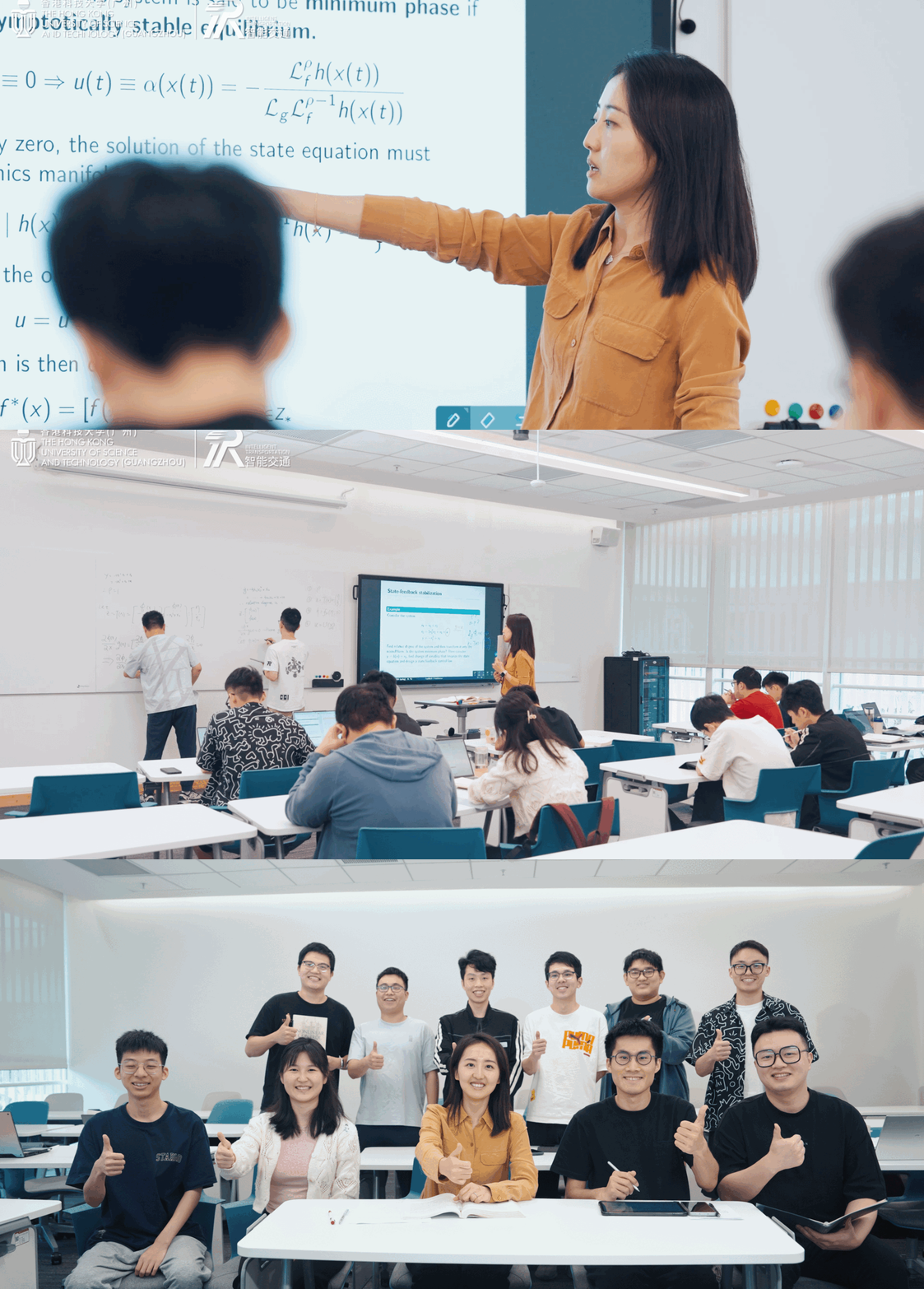
IFAC CPDE: Learning for Dynamics and Control of Mobility Systems
Description:
Modern urban mobility systems exhibit inherently complex and multi-scale dynamics where macroscopic traffic flow interacts with microscopic vehicle behaviors, shaping system-wide performance in congestion, efficiency, and safety. Emerging technologies—autonomous driving, wireless communication, and AI —are transforming urban mobility, from smart infrastructure management to connected autonomous vehicles (CAVs) design. This course explores how control theory, traffic science and machine learning methodologies can be used to model, analyze, and optimize urban mobility systems. The course is structured into three main parts:
Lecture I: Microscopic Traffic Flow Modeling and Control
This part introduces the fundamentals of traffic flow modeling at the vehicle level. It covers microscopic models for human-driven and connected automated vehicles (CAVs), model calibration, and how microscopic behaviors contribute to emergent traffic patterns and design CAV control to improve traffic.
Lecture II: Macroscopic Traffic Control via PDE Backstepping
The second part focuses on system-level traffic control using Partial Differential Equation (PDE)-based methods. Students will learn how to design infrastructure-based control strategies—such as variable speed limits and ramp metering—using backstepping techniques to stabilize freeway traffic and mitigate stop-and-go congestion.
Lecture III: Learning-Based Traffic Control: PINNs and Neural Operator
The final part explores how machine learning—particularly Physics-Informed Neural Networks (PINNs) and Neural Operators—can enhance traditional traffic flow modeling and control frameworks, providing improved generalization capabilities while preserving rigorous performance guarantees.
Two reference books for these lectures:
H. Yu and M. Krstic, Traffic congestion control by PDE backstepping. Springer, 2022.
A. Kesting and M. Treiber, Traffic flow dynamics: data, models and simulation. Springer, 2013.
INTR 5300 Nonlinear Control Systems
Description:
This course introduces methods for analysis and control design of nonlinear systems, which have a wide range of engineering applications including transportation, robotics, biology, energy, and manufacturing systems. Topics include mathematical modeling of nonlinear systems and the fundamental differences between linear and nonlinear dynamics; analytical tools such as phase plane analysis, Lyapunov stability, input-to-state and input-output stability, and approximation methods; as well as nonlinear control design techniques including feedback linearization, Lyapunov-based control, and backstepping. The course also incorporates machine learning-based modeling and control approaches to address emerging engineering challenges. From investigating the nonlinear phenomena to understanding the mathematical properties and then analyzing system behaviours, students will be able to grasp the fundamental concepts and advanced tools that are useful in the analysis of nonlinear systems. By the end of the course, students will be able to critically evaluate the strengths and limitations of various nonlinear methods and make informed choices of control strategies suited to different application and research problems.
INTR 5100 Traffic Flow Theory
Description:
Emerging technological innovations in autonomy, connectivity, and machine learning are revolutionizing vehicular traffic systems. The need for a comprehensive and systematic comprehension of traffic dynamics has become imperative to harness these innovations and reshape transportation systems. The course covers fundamentals of vehicular traffic flow dynamics and their various applications in traffic control. This course starts with how to obtain and interpret traffic flow data, which serves as the bedrock of quantitative traffic modeling. The second and main part delves into various approaches and models that offer mathematical descriptions of vehicular traffic flow, spanning from the microscopic to macroscopic level. The third part introduces major applications of traffic flow theory including classic traffic management schemes, mix-autonomy traffic flow modeling and advanced control and sensing strategies by connected and automated vehicles. Students will be able to grasp key concepts and the physics behind various traffic phenomena, and have a better understanding of driving behaviours and intelligent traffic management from a systematic level. This course is designed to help students develop fundamental skills of transportation field and knowledge, connect with the state-of-art transportation problems and equip them for more advanced studies in intelligent transportation systems.
 Yu Research Group @ HKUST(GZ)